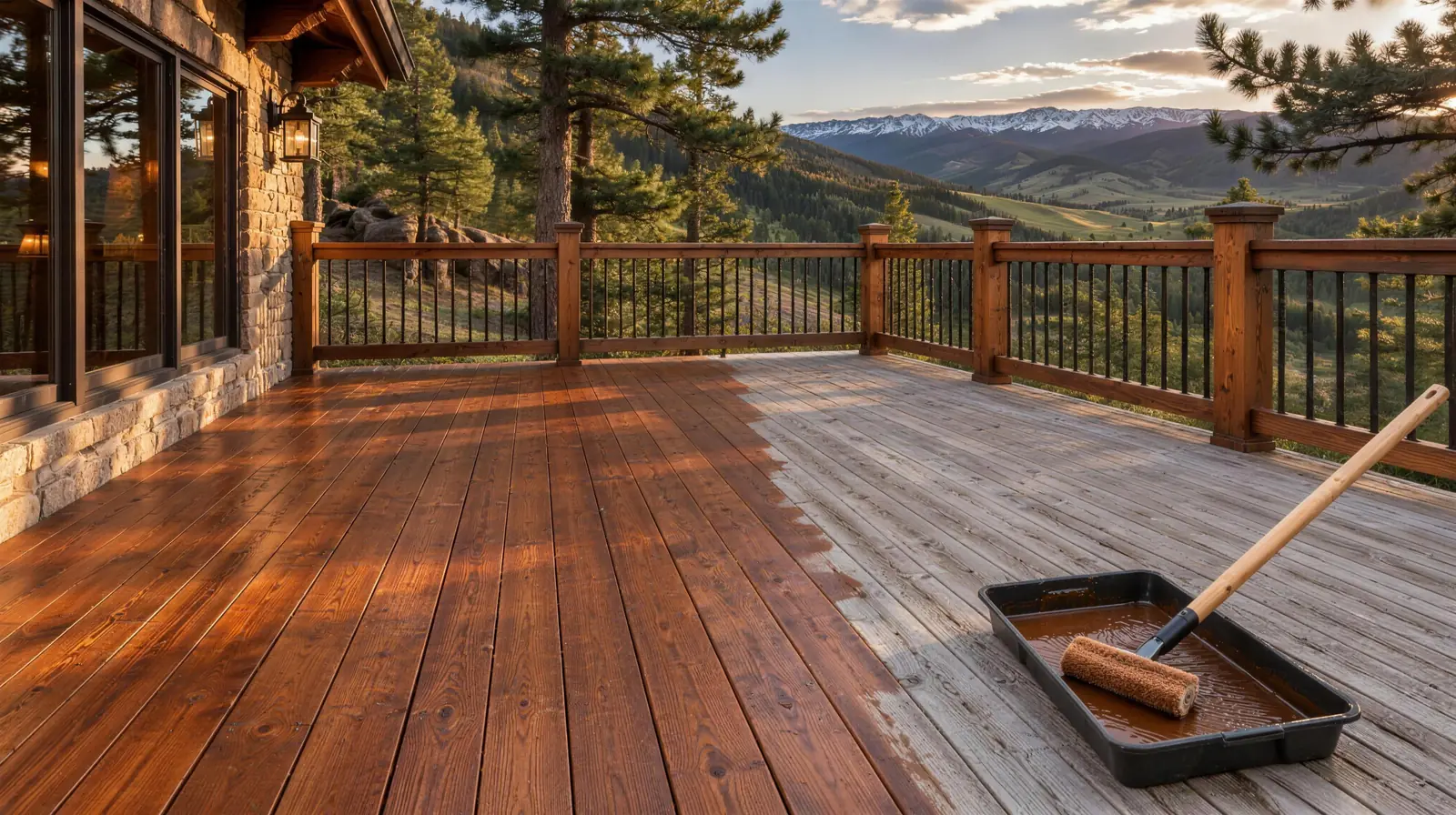
Fall deck staining in Colorado is a countdown, and the step that runs out of time is rarely the staining itself. It is the drying. A deck has to be cleaned, then dry out completely, then get stain on a day warm enough for it to soak in and set before the evening dew. In October those good days get scarce, so the work has to be planned backward from the last coat.
Here is the sequence we follow on deck and fence staining jobs this time of year, from three weeks out to the week after.
| Phase | Weather it needs | Check before moving on |
|---|---|---|
| Testing and repairs | Any dry day | Loose boards, popped fasteners and soft spots are fixed |
| Cleaning or stripping | Above the cleaner's label minimum, no freeze that night | Gray fibers and old failing finish are gone |
| Drying | Dry days, ideally with sun and some wind | Moisture meter reading within the stain label's limit |
| Staining | Above the stain's minimum through the drying window, no rain or snow forecast | Even absorption, no puddles left on the surface |
| Setting | No precipitation for the period on the label | Surface dry and not tacky before furniture goes back |
Three weeks out: test the boards and read the forecast
Start with a water test. Sprinkle water across a few boards in sun and in shade. If it beads up, the old finish is still repelling water and new stain will not soak in; that deck may need stripping, or it may not need stain this year. If the water darkens the wood and disappears quickly, the boards are ready to take stain once they are clean.
Then look at elevation and the long-range forecast together. A deck in Castle Rock, which sits well above Denver, tends to lose its fall staining weather earlier than one in the metro. The same goes for decks on shaded north sides of a house, under big trees, or tucked against a hillside. Those boards dry slower after cleaning and stay cold longer in the morning.
Two weeks out: repairs, then cleaning
Fix the deck before you clean it. Reset or replace popped nails and screws, swap out boards that are soft when probed with an awl, and sand any splintered edges. Rot at board ends and around posts is common where snow sits all winter. If repairs go beyond a few boards, our exterior prep and repair work covers board replacement and wood repair before any finish goes on.
Cleaning depends on what is on the boards:
- Gray, weathered wood with no film gets a deck cleaner made for the job, usually oxygen-bleach based, then a thorough rinse.
- Peeling solid or film-forming stain needs a stripper, followed by a wood brightener that neutralizes it and restores color.
- Mildew in shaded corners calls for a cleaner rated for mildew, applied per the label and rinsed well.
- Pressure washing, if used at all, means low pressure and a wide fan tip held at a distance, because high pressure gouges and fuzzes softwood.
UV turns the surface fibers of unprotected wood gray. That gray layer is degraded wood, and stain applied over it bonds to loose fibers. It has to come off.
The drying gap
This is where fall schedules break. In summer a cleaned deck may dry quickly. In October, with cool nights, morning dew and lower sun, it takes longer, and shaded boards take longer still. The stain label lists a moisture limit for the wood, and a moisture meter is the only reliable way to know you are under it.
Stain day
The working window on an October stain day is short. It opens once the dew has burned off the boards and the wood is above the label minimum. It closes early enough that the stain has time to soak in and dry before the evening temperature drop brings dew back.
Choosing the product for cool weather
If this, then that
- If the forecast shows only a few marginal days, then check the minimum temperature on the labels first. Some water-based and some oil-based stains are formulated for cooler application, and the label is the only place that tells you.
- If you are using an oil-based penetrating stain, then expect slower drying in the cold and plan for a longer gap before foot traffic.
- If the deck had a water-based stain before, then stay with a compatible product unless you are stripping to bare wood.
- If the product calls for a second coat while the first is still wet, then do both on the same day; if it calls for a dry first coat, the recoat time on the label applies, and it runs longer in the cold.
Application details that matter in fall
Work a few boards at a time along their full length, so the stain does not dry in lap marks across a board. Apply thin. A penetrating stain that puddles stays soft and tacky on the surface, and in cool weather it may stay that way for a long time. Back-brush or wipe excess per the label. Do horizontal boards and the top of railings with care, because they take the most sun and snow.
The week after the last coat
Keep furniture, grills and planters off until the label's cure guidance says otherwise. Rugs and doormats trap moisture against a fresh finish. Wet leaves left in piles can stain the boards, so sweep them off as they fall. When snow arrives, use a plastic shovel pushed along the length of the boards, not across them, and skip rock salt on a stained deck.
If the season closed before the last coat went on, a clean, dry, repaired deck waiting for spring is still in better shape than one that was stained into damp wood.
Request an estimate for deck or fence staining, and we will tell you whether this fall's forecast leaves room for the full sequence.