Start by identifying the stucco
Front Range houses carry three broad kinds of stucco, and they don't take the same coatings. Traditional cement stucco is a hard, multi-coat plaster of portland cement, lime and sand over lath. Many newer homes have a cement base with an acrylic finish coat on top. EIFS, often called synthetic stucco, is foam insulation board with a reinforced base coat and a textured acrylic finish.
A firm knuckle tap tells you a lot. Cement stucco feels like rock. EIFS sounds hollow and can dent under a thumb. Stucco, often paired with stone veneer and some lap siding, is common across many 1990s and 2000s subdivisions in Highlands Ranch, Castle Rock, Parker and Colorado Springs.
| Surface | How to recognize it | Coating direction |
|---|---|---|
| Cement stucco, never painted | Hard; color runs through the material and fades unevenly | Painting commits you to future repaints; a cementitious color coat (fog coat) is the alternative |
| Cement stucco, painted before | Hard; a paint film shows at chips and cracks | 100% acrylic masonry paint or elastomeric, compatible with the existing coating |
| Acrylic finish over cement | Hard base, slightly rubbery finish texture | Acrylic masonry coatings after a chalk and adhesion check |
| EIFS (synthetic stucco) | Hollow sound, softer surface, foam visible at damage | Coatings the EIFS maker lists as compatible; check for moisture at windows first |
Breathable acrylic or elastomeric coating
Two product categories cover most stucco repaints. A 100% acrylic masonry paint goes on as a relatively thin film, keeps the texture crisp and stays breathable, so vapor moving outward through the wall can escape. On a sound wall it's the safer default.
Elastomeric coating is a much thicker, rubbery film designed to stretch across hairline cracks as the wall moves. It goes on at a heavier film build than paint (the data sheet gives the spread rate) and does a good job keeping wind-driven rain out. The tradeoff is lower vapor permeability. If water is getting into the wall from behind, through a leaky window flashing, a sprinkler soaking the base, or soil piled up against the weep screed, elastomeric can hold that moisture in and blister.
If this, then that
- If the stucco is sound with few cracks, then a quality 100% acrylic masonry paint is usually the right call.
- If a wall has a network of hairline cracks but stays dry, then elastomeric bridges them and slows water entry.
- If you see efflorescence, staining under windows or soft spots, then find the water source before choosing any coating.
- If the wall is EIFS, then the EIFS maker's list of compatible coatings makes the decision.
The prep sequence on a stucco wall
Most stucco paint failures trace back to prep, not to the paint.
- Wash at moderate pressure to remove chalk, dust and cobwebs. High pressure erodes the finish and drives water into cracks, and the wall has to dry fully before anything else happens.
- Look for efflorescence, the white salt deposits left when water moves through masonry. Brush it off and trace the moisture before painting over it.
- Repair cracks. Hairlines get a brush-grade elastomeric patch. Wider cracks are opened up, filled with a compatible stucco patch and textured to match.
- Let patches cure. Fresh cement patch is strongly alkaline, and alkali attacks paint. Wait the time the patch maker lists, then spot prime with an alkali-resistant masonry primer.
- Seal around windows, doors and penetrations with a sealant rated for masonry. Leave the weep screed at the base of the wall open so the wall can drain.
- Mask windows, light fixtures, hardware and plantings.
Spraying and back-rolling stucco
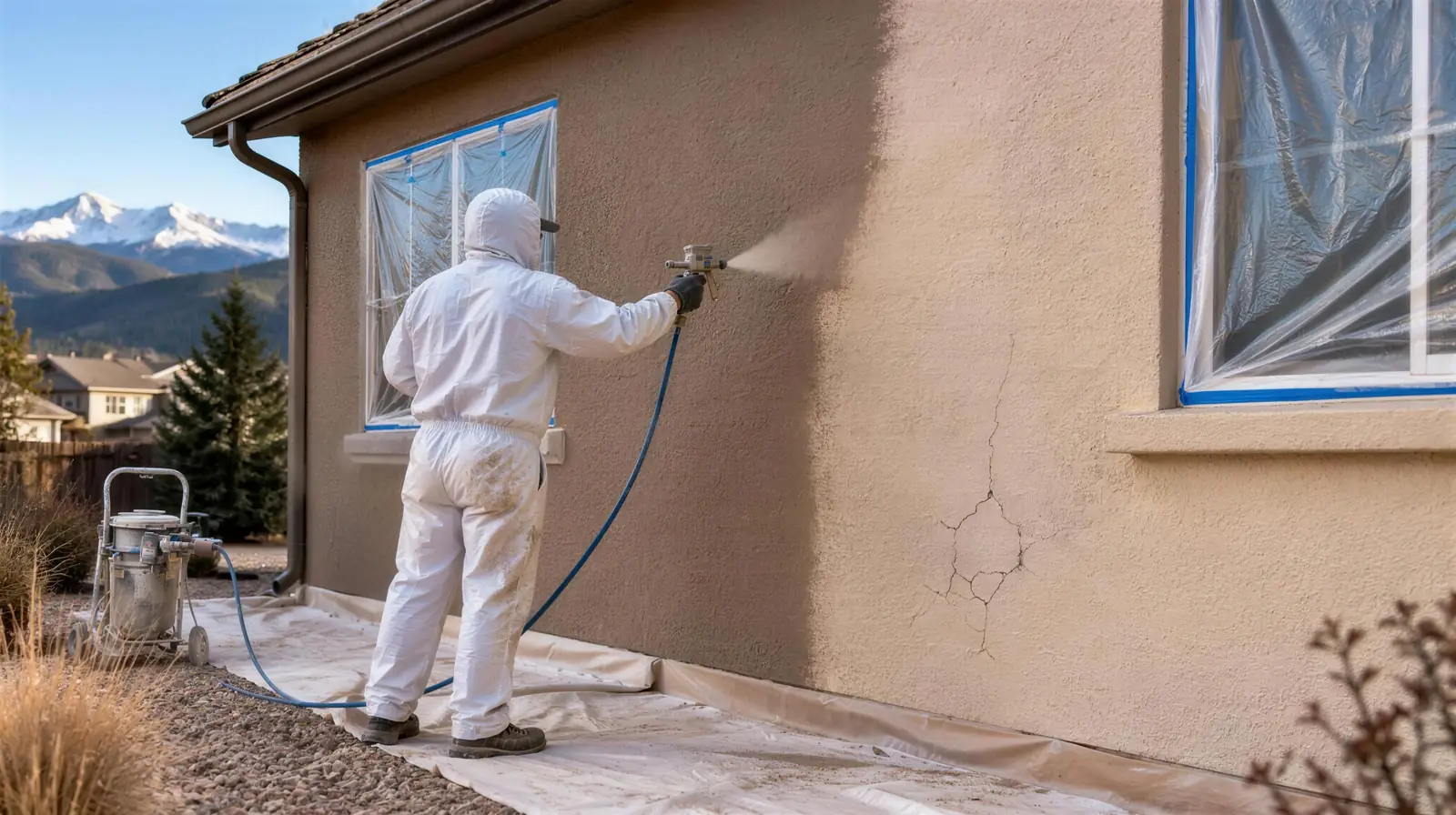
Stucco texture is full of pits and ridges. An airless sprayer alone puts paint on the high points and leaves pinholes in the shadows, and pinholes let water in. Back-rolling right behind the sprayer with a thick-nap roller works the coating into the texture. It's slower. It's also the difference between a wall that looks painted and one that's actually sealed.
Stucco uses much more material per square foot than smooth siding. The data sheet lists a spread rate for rough masonry, and a color change usually needs two full coats to reach the film thickness the coating was designed for.
Why south and west stucco fails first
Ultraviolet light breaks down the binder in paint, and there's more of it at elevation than at sea level. On the Front Range, south and west walls take the longest sun exposure and the hottest afternoon heat, so they chalk and fade years ahead of the north side.
Then there's movement. A wall that bakes in the afternoon and drops below freezing at night expands and contracts every day of the shoulder seasons. Water that gets into a hairline crack freezes, expands and opens the crack a little wider each cycle. Hail chips and pits the finish, and sprinklers that hit the lower few feet of wall keep the base wet. Darker colors absorb more heat, which is why some EIFS makers limit how dark a color can go, measured by its light reflectance value (LRV), a number most paint makers publish for each color.
What to ask before a stucco repaint
- Is the wall cement stucco, an acrylic finish or EIFS, and how was that confirmed?
- Which cracks get patched, with what material, and how will texture be matched?
- Will patches get an alkali-resistant primer once they cure?
- Acrylic or elastomeric, and why that choice for this wall?
- Spray only, or spray and back-roll?
- How many coats, and what film build does the data sheet call for?
- How will weep screeds and drainage gaps stay open?
Stucco rarely gets painted alone. Wood trim, fascia and the garage door usually go on the same schedule (see trim and fascia painting), and the crack, moisture and caulking work is part of our exterior prep and repair service. Homes in covenant-controlled neighborhoods also need color approval before work starts.
Request an estimate and we'll look at the stucco in person, check the chalk and cracks, and write the scope out surface by surface.